Londres posee una enorme cantidad de sitios y monumentos para ver y disfrutar.
He aquí algunos muy significativos. Son sólo una muestra.
Pincha en cada palabra resaltada en amarillo si quieres obtener más información.
O puedes visitar esta página:http://www.tourist-information-uk.com/attractions/
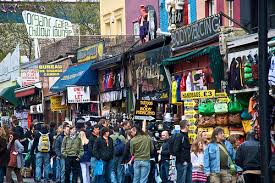
Camden Lock Market: This is- both an open-air and a covered market in North London. It specialises mainly in clothes, antiques, arts, crafts and novelties.
He aquí algunos muy significativos. Son sólo una muestra.
Pincha en cada palabra resaltada en amarillo si quieres obtener más información.
O puedes visitar esta página:http://www.tourist-information-uk.com/attractions/
Camden Lock Market: This is- both an open-air and a covered market in North London. It specialises mainly in clothes, antiques, arts, crafts and novelties.
The South Bank Centre is a cultural complex on the south side of the River Thames in central London. It consists of the National Theatre, the National Film Theatre, the Museum of the Moving Image, the Hayward Gallery, The Festival Concert Hall and other small concert halls, art galleries and open-air exhibition sites. One of these open-air sites is Jubilee Gardens.
Chelsea, Kings Road: This area of London, and the King's Road in particular, is still thought to be the home of avant-garde fashion.
The East End: The terms East End and West End have special meaning for Londoners. The East End covers the whole area of East London where people live and work. It was once a traditional working class area based on the London docks. The closeness of the East End to the City of London - the business and financial centre of London has made it an attractive and profitable place for development.

The West End refers specifically to the theatre, entertainment and shopping area of central London. The other geographical areas of London are referred to as North London, South London and West London.

Waterloo: A mainline and underground station in London, near the South Bank Centre. Embankment: The underground station immediately opposite the Centre on the other side of the River Thames. There is a pedestrian bridge over the river at this point.
THE MONUMENT
The Monument is a hollow column that rises up to 202 ft. and commemorates the Great Fire of London of 1666. It was set up in 1671-77, at a distance of exactly 202 ft. from the baker's shop in Pudding Lane where the fire started. On top of the Doric column there is a square platform for visitors who climb the 311 steps inside the column, and crowning everything there is a flaming urn. The high buildings nearby have changed the view of and from the Monument, but nevertheless it remains here as a conspicuous memorial in the City of London to the destruction that ravaged the area a little more than 300 years ago.
THE ALBERT MEMORIAL
This well-known monument commemorating the Prince Consort, Queen Victoria's husband, stands in Kensington Gardens, opposite the Albert Hall. This latter building is famous nowadays for the summer series of concerts which are held there every year, called the 'Proms' or 'Promenade Concerts'.
The monument to Prince Albert was unveiled by Queen Victoria in 1876. It is a typical representation of the aesthetic ideal of the mid-Victorian age. Four wide flights of steps lead to the neo-gothic spire, 175 ft. high, adorned with pinnacles and mosaics. The 14ft. bronze figure of the Prince sits under a canopy surrounded by allegorical groups and a frieze of figures of artists. There is no better way to understand the taste of the period than to study this memorial.

EROS
Everybody knows Piccadilly Circus, the famous centre of entertainment, and traffic, in the West End of London. Once we are there, we must see important streets, such as Piccadilly, Regent Street or Shaftesbury Avenue, which meet at that point.
But who was Shaftesbury? The 7th Earl of Shaftesbury was one of the greatest social reformers in 19th century England. The movement for shortening the working day in the textile mills, over which he presided, succeeded in reducing it to ten hours a day. Under his impulse, too, laws were issued prohibiting all women and girls, and all boys under 13, from working in the coal-mines.
In memory of Lord Shaftesbury a fountain was built in the middle of the circus, and the statue crowning the fountain is what the artist. Sir Alfred Gilbert, meant to be the Angel of Christian Charity. It was cast in aluminium and put up in 1893. This statue has been popularly called Eros for a very long time, on account of a possible resemblance to the Greek god of love. Few of the millions of visitors from all over the world that sit or lie on the steps of the stone island are aware of the whole story as they watch or photograph the friendly figure.
HYDE PARK
This is both the largest and the most famous park in London. An ancient royal hunting ground, once part of Henry VIII's properties, it occupies, together with Kensington Gardens, an extension of 615 acres in the centre of one of the greatest cities in the world. The original entrance to Hyde Park is at the southeast corner and from there a well-known riding path. Rotten Row, begins.
Another important feature is the lake, known in the Park as the Serpentine and in the Gardens as the Long Water. On the Serpentine you can go boating and sailing, and even swimming at a strand called the Lido, the first to be developed in London. You can have one of the finest views from the beautiful stone bridge which separates the Serpentine from the Long Water.
To the north of the lake Is the Hudson Bird Sanctuary. Since there are more than 90 species of birds in the park, bird-watchers can also have a good time there. At Marble Arch Corner is Speakers' Corner, the traditional centre of free speech.
Again a royal hunting ground, part of Henry Vlll's hunting preserve. It occupies an area of 472 acres and it was laid out by the famous architect Nash as a park for a house which the Prince Regent planned to build in the last century. It offers amenities such as a yachting and boating lake, and a special boating pond for children. Queen Mary's Gardens are worth visiting on account of their beautiful roses.
There are wonderful avenues of chestnuts and elms, tennis courts, different playing fields an open air theatre, and two unique features compared to the other parks in London-'the Canal and the Zoological Gardens. The Regent's Canal is part of the old industrial system of waterways. There are motorised barges running excursions and in summer there is a Zoo Waterbus service to and from the Zoo.
There are wonderful avenues of chestnuts and elms, tennis courts, different playing fields an open air theatre, and two unique features compared to the other parks in London-'the Canal and the Zoological Gardens. The Regent's Canal is part of the old industrial system of waterways. There are motorised barges running excursions and in summer there is a Zoo Waterbus service to and from the Zoo.
ST. JAMES'S PARK.
The oldest royal park in London goes back to Henry VIII, who built St. James's Palace. It is worth remembering that the credentials of foreign diplomats are still addressed to the court of St. James. Henry also added the park to the palace. As the ground was a swampy field, it had to be drained first, and then it was turned into a nursery for deer. Later on a menagerie of animals and exotic birds was established.
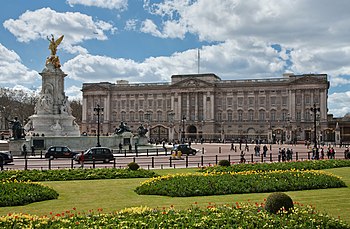
The islands of the small and irregular lake are full of duck and many species of wildfowl, among which the pelicans are especially well-known. The flower beds, shrubberies and trees are beautiful at any time of the year and form a typical English landscape. From the small bridge and the weeping willows around the lake there are fine views of Buckingham Palace and Whitehall. The park is limited to the north by The Mall, the splendid avenue that ends at the Queen Victoria Memorial.
The islands of the small and irregular lake are full of duck and many species of wildfowl, among which the pelicans are especially well-known. The flower beds, shrubberies and trees are beautiful at any time of the year and form a typical English landscape. From the small bridge and the weeping willows around the lake there are fine views of Buckingham Palace and Whitehall. The park is limited to the north by The Mall, the splendid avenue that ends at the Queen Victoria Memorial.