THE ENGLISH CLUB

Mostrando entradas con la etiqueta BRITISH CULTURE AND TRADITION. Mostrar todas las entradas
Mostrando entradas con la etiqueta BRITISH CULTURE AND TRADITION. Mostrar todas las entradas
1 de noviembre de 2013
9 de abril de 2013
MARGARET THATCHER DIES
Margaret Thatcher's death
evokes polarized reaction
British politician had strong admirers, equally vocal opponents.
Former Prime Minister Baroness Thatcher has died "peacefully" at the age of 87 after suffering a stroke while staying at the Ritz hotel in central London.

http://www.bbc.co.uk/news/uk-politics-22067155
http://en.wikipedia.org/wiki/Margaret_Thatcher
evokes polarized reaction
British politician had strong admirers, equally vocal opponents.
Former Prime Minister Baroness Thatcher has died "peacefully" at the age of 87 after suffering a stroke while staying at the Ritz hotel in central London.
David Cameron called her a "great Briton" and the Queen spoke of her sadness at the death. Lady Thatcher was Conservative prime minister from 1979 to 1990. She was the first woman to hold the role.
She will not have a state funeral but will be accorded the same status as Princess Diana and the Queen Mother.The ceremony, with full military honours, will take place at London's St Paul's Cathedral.
http://www.bbc.co.uk/news/uk-politics-22067155
http://en.wikipedia.org/wiki/Margaret_Thatcher
10 de febrero de 2013
VALENTINE`S DAY

 |
| Saint Valentine |
26 de diciembre de 2012
BOXING DAY
.jpg)
The exact etymology of the term "boxing" is unclear. There are several competing theories, none of which is definitive.The European tradition, which has long included giving money and other gifts to those who were needy and in service positions, has been dated to the Middle Ages, but the exact origin is unknown. It may come from a custom in the late Roman/early Christian era, wherein metal boxes placed outside churches were used to collect special offerings tied to the Feast of Saint Stephen, which in the Western Church falls on the same day as Boxing Day.
In Britain, it was a custom for tradesmen to collect "Christmas boxes" of money or presents on the first weekday after Christmas as thanks for good service throughout the year.This is mentioned in Samuel Pepys' diary entry for 19 December 1663. This custom is linked to an older English tradition: Since they would have to wait on their masters on Christmas Day, the servants of the wealthy were allowed the next day to visit their families. The employers would give each servant a box to take home containing gifts and bonuses, and sometimes leftover food
http://en.wikipedia.org/wiki/Boxing_Day
http://britishfood.about.com/od/christmas/p/boxingday.htm
http://gouk.about.com/od/whatsonindecember/qt/boxing_day.htm
25 de diciembre de 2012
THE BRITISH MONARCHY AND CHRISTMAS

Each year at 15:00GMT on Christmas Day, The Queen's Broadcast to the Commonwealth (popularly known as 'The Queen's Speech') is broadcast.
19 de noviembre de 2012
HUMPTY DUMPTY

Humpty Dumpty was a colloquial term used in fifteenth century England describing someone who was obese. This has given rise to various, but inaccurate, theories surrounding the identity of Humpty Dumpty. The image of Humpty Dumpty was made famous by the illustrations included in the 'Alice through the looking glass' novel by Lewis Carroll. However, Humpty Dumpty was not a person pilloried in the famous rhyme!
The character of Humpty Dumpty was popularised in the United States by actor George L. Fox (1825–77).
http://es.wikipedia.org/wiki/Humpty_Dumpty
http://www.rhymes.org.uk/humpty_dumpty.htm
http://es.wikipedia.org/wiki/Humpty_Dumpty
http://www.rhymes.org.uk/humpty_dumpty.htm
Lyrics
Humpty Dumpty sat on a wall,
Humpty Dumpty had a great fall.
All the king's horses and all the king's men
Couldn't put Humpty together again.
1 de noviembre de 2012
INTERESTING FACTS ABOUT ENGLISH
- The most common letter in English is "e".
- The most common vowel in English is "e", followed by "a".
- The most common consonant in English is "r", followed by "t".
- Every syllable in English must have a vowel (sound). Not all syllables have consonants.
- Only two English words in current use end in "-gry". They are "angry" and "hungry".
- The word "bookkeeper" (along with its associate "bookkeeping") is the only unhyphenated English word with three consecutive double letters. Other such words, like "sweet-toothed", require a hyphen to be readily readable.
- The word "triskaidekaphobia" means "fear of Friday the 13th". It also means "superstition about the number thirteen" in general.
- More English words begin with the letter "s" than with any other letter.
- A preposition is always followed by a noun (ie noun, proper noun, pronoun, noun group, gerund).
- The word "uncopyrightable" is the longest English word in normal use that contains no letter more than once.
- A sentence that contains all 26 letters of the alphabet is called a "pangram".The following sentence contains all 26 letters of the alphabet: "The quick brown fox jumps over the lazy dog." This sentence is often used to test typewriters or keyboards.
- The only word in English that ends with the letters "-mt" is "dreamt" (which is a variant spelling of "dreamed") - as well of course as "undreamt" :)
- A word formed by joining together parts of existing words is called a "blend" (or, less commonly, a "portmanteau word"). Many new words enter the English language in this way. Examples are "brunch" (breakfast + lunch); "motel" (motorcar + hotel); and "guesstimate" (guess + estimate). Note that blends are not the same as compounds or compound nouns, which form when two whole words join together, for example: website, blackboard, darkroom.
- The word "alphabet" comes from the first two letters of the Greek alphabet: alpha, bēta.
- The dot over the letter "i" and the letter "j" is called a "superscript dot".
- In normal usage, the # symbol has several names, for example: hash, pound sign, number sign.
- In English, the @ symbol is usually called "the at sign" or "the at symbol".
- Some words exist only in plural form, for example: glasses (spectacles), binoculars, scissors, shears, tongs, gallows, trousers, jeans, pants, pyjamas (but note that clothing words often become singular when we use them as modifiers, as in "trouser pocket").
- The shortest complete sentence in English is the following. "I am."
- The word "Checkmate" in chess comes from the Persian phrase "Shah Mat" meaning "the king is helpless".
- We pronounce the combination "ough" in 9 different ways, as in the following sentence which contains them all: "A rough-coated, dough-faced, thoughtful ploughman strode through the streets of Scarborough; after falling into a slough, he coughed and hiccoughed."
- The longest English word without a true vowel (a, e, i, o or u) is "rhythm".
- The only planet not named after a god is our own, Earth. The others are, in order from the Sun, Mercury, Venus, [Earth,] Mars, Jupiter, Saturn, Uranus, Neptune.
- There are only 4 English words in common use ending in "-dous": hazardous, horrendous, stupendous, and tremendous.
- We can find 10 words in the 7-letter word "therein" without rearranging any of its letters: the, there, he, in, rein, her, here, ere, therein, herein.
- There is no egg in eggplant nor ham in hamburger; neither apple nor pine in pineapple.
- English muffins weren't invented in England or French fries in France.
- Sweetmeats are candies while sweetbreads, which aren't sweet, are meat.
- Quicksand works slowly, boxing rings are square and a guinea pig is neither from Guinea nor is it a pig.
- And why is it that writers write but fingers don't fing, grocers don't groce and hammers don't ham?
- If the plural of tooth is teeth, why isn't the plural of booth beeth?
- One goose, 2 geese. So one moose, 2 meese?
- If a vegetarian eats vegetables, what does a humanitarian eat?
- In what language do people recite at a play and play at a recital?
- Have noses that run and feet that smell?
- English was invented by people, not computers, and it reflects the creativity of the human race, which, of course, is not a race at all.
28 de octubre de 2012
HALLOWEEN
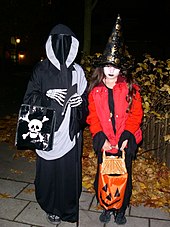
Halloween or Hallowe'en (a contraction of its original title "All Hallows' Evening") also known as All Hallows' Eve is a yearly holiday observed around the world on October 31, the eve of the Western Christian feast of All Hallows. Most scholars believe that All Hallows' Eve was originally influenced by western European harvest festivals and festivals of the dead with pagan roots, particularly the Celtic Samhain.Others maintain that it originated independently of Samhain.
Typical festive Halloween activities include trick-or-treating (also known as "guising"), attending costume parties, carving pumpkins into jack-o'-lanterns, lighting bonfires, apple bobbing, visiting haunted attractions, playing pranks, telling scary stories, and watching horror films.
How did Halloween come about in Spain?
Halloween is more popular in the north of Spain due to ancestral links with celtic ancestors who arrived in this region around 3,000 years ago. Despite mixing with the indigenous Iberian culture, a great interest came about in holidays and celebrations imported from the Celtic world.
How do they celebrate Halloween in Spain?
Although Halloween is still a relatively new phenomenon in Spain, the Spanish people go all out for celebrating it to the maximum as with any kind of fancy dress festival. You will see many more people dressed up in outrageous costumes and parading the streets in larger groups than you would ever see in England. It is more popular in the north of Spain and celebrated much more in larger cities where you are bound to be invited to a costume party or see posters advertising them everywhere. Most shops and cafes have baskets of treats outside for trick or treaters.
Along Galicia’s northern coast it is traditional to carve pumpkins, light bonfires and consume “quemadas” fire water infused with herbs – claimed to be an ancient drink originating from the Celtic people a symbolic act to burn off bad luck and the negative energy associated with Halloween.
Activities for halloween
3 de junio de 2012
QUEEN'S DIAMOND JUBILEE
60 years of history in the UK, the world and the Royal Family

http://www.telegraph.co.uk/news/uknews/the_queens_diamond_jubilee/9308110/Diamond-Jubilee-Queen-voted-favourite-monarch-of-all-time.html
Interactive Queen's timeline.
http://www.telegraph.co.uk/news/uknews/the_queens_diamond_jubilee/9305109/Queens-Diamond-Jubilee-timeline-60-years-of-history-in-the-UK-the-world-and-the-Royal-Family.html
22 de abril de 2012
SAINT GEORGE'S DAY
Saint George is the patron saint of England. He's popularly
identified with England and English ideals of honour, bravery and
gallantry - but actually he wasn't English at all. Very little, if
anything, is known about the real Saint George. He is patron saint not only of England but also of Aragon, Catalonia,
Georgia, Lithuania, Palestine, Portugal, Germany and Greece; and of
Moscow, Istanbul, Genoa and Venice (second to Saint Mark). He's also
patron saint of soldiers, archers, cavalry and chivalry, farmers and
field workers, riders and saddlers, and he helps those suffering from
leprosy, plague and syphilis. In recent years he has been adopted as
patron saint of Scouts.
Everything about Saint George is dubious, so the information below should be taken as mythical rather than real.
- Born in Cappadocia, an area which is now in Turkey
- Lived in 3rd century AD
- His parents were Christian
- Later lived in Palestine
- Became a Roman soldier
- Protested against Rome's persecution of Christians
- Imprisoned and tortured, but stayed true to his faith
- Beheaded at Lydda in Palestine
- 23rd April was named as Saint George's day in 1222

England
"St George's Day" is celebrated by the several nations, kingdoms, countries, and cities of which Saint George is the patron saint. St George's Day is celebrated on 23rd April, the traditionally accepted date of Saint George's death in AD 303. For Eastern Orthodox Churches who use the Julian calendar, 23rd April corresponds to 6th May on the Gregorian calendar.

A traditional custom on St George's day is to wear a red rose in one's lapel, though this is no longer widely practised. Another custom is to fly or adorn the St George's Cross flag in some way: pubs in particular can be seen on 23rd April festooned with garlands of St George's crosses. It is customary for the hymn "Jerusalem" to be sung in cathedrals, churches and chapels on St George's Day, or on the Sunday closest to it. Traditional English foods and drink (e.g. afternoon tea) may be consumed.
Spain

As in the rest of the ancient Crown of Aragon, the Feast of St George is celebrated enthusiastically in the Community of Aragon,
being the country's patron saint and its national day. As in Catalonia, roses and books are exchanged among individuals, often bearing ribbons with the colors of Aragon's flag. Valencia celebrates St George's Day with a different intensity, though in several zones it has similarities to Valentine's Day, like in Catalonia.

 April 23rd was chosen as World Book Day and Copyright Day, because it corresponds to the demise of the writers Miguel de Cervantes, William Shakespeare and Inca Garcilaso de la Vega on the same date in 1616 (although it really is not : Cervantes died on 22nd and was buried on 23rd, while Shakespeare died on April 23rd ... in the Julian calendar, which corresponds to 6th May in the Gregorian calendar). On this date also died William Wordsworth (in 1850) and Josep Pla (in 1981).
 The International Publishers Association proposed this date to Unesco, with the aim of promoting culture and the protection ofintellectual property through copyright.


8 de abril de 2012
EASTER
Easter has been called a moveable feast because it doesn't fall on a set date every year, as most holidays do. Instead, Christian churches in the West celebrate Easter on the first Sunday following the full moon after the vernal equinox on March 21. Therefore, Easter is observed anywhere between March 22 and April 25 every year.
Easter Sunday is the culmination of Holy Week. Easter commemorates the resurrection of Jesus Christ. It is the most important Christian festival, and the one celebrated with the
greatest joy. The date of Easter changes each year, and several other Christian festivals fix their dates by reference to Easter. Churches are filled with flowers, and there are special hymns and songs. But not all Easter customs are Christian; some, such as the Easter Bunny, are pagan in origin.
The exact origins of this religious feast day's name are unknown. Some
sources claim the word Easter is derived from Eostre, a Teutonic goddess
of spring and fertility. Other accounts trace Easter to the Latin term "hebdomada alba", or white week, an ancient reference to Easter week and
the white clothing donned by people who were baptized during that time.
Through a translation error, the term later appeared as "esostarum" in Old
High German, which eventually became Easter in English.
In Spanish, Easter is known as Pascua; in French, Paques. These words are derived from the Greek and Latin Pascha or Pasch, for Passover. Jesus' crucifixion and resurrection occurred after he went to Jerusalem to celebrate Passover (or Pesach in Hebrew), the Jewish festival commemorating the ancient Israelites' exodus from slavery in Egypt. Pascha eventually came to mean Easter.
Easter Bunny

According to some sources, the Easter bunny first arrived in America in the 1700s with German immigrants who settled in Pennsylvania and transported their tradition of an egg-laying hare called "Osterhase" or "Oschter Haws." Their children made nests in which this creature could lay its colored eggs. Eventually, the custom spread across the U.S. and the fabled rabbit's Easter morning deliveries expanded to include chocolate and other types of candy and gifts, while decorated baskets replaced nests. Additionally, children often left out carrots for the bunny in case he got hungry from all his hopping.
Easter Eggs

Easter Candy

4 de marzo de 2012
BRITISH ENGLISH AND AMERICAN ENGLISH
British English (BrE) is the form of English used in the United Kingdom. It includes all English dialects used within the United Kingdom.
American English (AmE) is the form of English used in the United States. It includes all English dialects used within the United States.
Click on the image to know more

American English (AmE) is the form of English used in the United States. It includes all English dialects used within the United States.
Click on the image to know more
27 de febrero de 2012
ENGLISH or BRITISH?: ALL YOU WANT TO KNOW
'When people say England, they sometimes mean Great Britain,
sometimes the United Kingdom,
sometimes the British Isles - but never England.'
'How to be an Alien' by George Mikes
Where did the name England come from?
Questions about Great Britain
 What is Great Britain?
Is Britain the same as Great Britain?
Which countries are in Great Britain?
Who gave Britain its name?
Find out about Great Britain
Questions about the United Kingdom
 Where is the UK?
What countries make up the UK?
What is the official title (name) of the UK?
Why is the whole of Ireland not part of the UK?
How and why was the UK formed?
Find out about the UK
Questions about the British Isles
Find out about the British Isles
'How to be an Alien' by George Mikes

Questions about Great Britain
Is Britain the same as Great Britain?
Which countries are in Great Britain?
Who gave Britain its name?
Find out about Great Britain
Questions about the United Kingdom
What countries make up the UK?
What is the official title (name) of the UK?
Why is the whole of Ireland not part of the UK?
How and why was the UK formed?
Find out about the UK
Questions about the British Isles

Suscribirse a:
Entradas (Atom)