THE ENGLISH CLUB

Mostrando entradas con la etiqueta FESTIVALS AND CELEBRATIONS. Mostrar todas las entradas
Mostrando entradas con la etiqueta FESTIVALS AND CELEBRATIONS. Mostrar todas las entradas
1 de noviembre de 2013
28 de febrero de 2013

10 de febrero de 2013
VALENTINE`S DAY

 |
| Saint Valentine |
29 de diciembre de 2012
DAY OF INNOCENT SAINTS
The Day of the Innocent Saints falls on the 28th of December. It is a festivity of religious origin. It is celebrated today as a fun and lighthearted day in which jokes are played on family and friends .It is the Spanish equivalent of April fools' day!
The Day of the Innocents is a commemoration of Christianity: the killing of all children under two years born in Bethlehem (Judea), ordered by King Herod to get rid of the newborn Jesus of Nazareth .
Massacre of the Innocents is the biblical narrative of infanticide and gendercide by Herod the Great, the Roman appointed King of the Jews. The historicity of the incident is "an open question that probably can never be definitively decided", but according to the Gospel of Matthew. Herod ordered the execution of all young male children in the village of Bethlehem, so as to avoid the loss of his throne to a newborn King of the Jews whose birth had been announced to him by the Magi.
 |
| Massacre of the Innocents - by Pieter Pauwel RUBENS |
The number of infants killed is not stated, however the Holy Innocents have been claimed as the first Christian martyrs.

http://en.wikipedia.org/wiki/Massacre_of_the_Innocents
26 de diciembre de 2012
BOXING DAY
.jpg)
The exact etymology of the term "boxing" is unclear. There are several competing theories, none of which is definitive.The European tradition, which has long included giving money and other gifts to those who were needy and in service positions, has been dated to the Middle Ages, but the exact origin is unknown. It may come from a custom in the late Roman/early Christian era, wherein metal boxes placed outside churches were used to collect special offerings tied to the Feast of Saint Stephen, which in the Western Church falls on the same day as Boxing Day.
In Britain, it was a custom for tradesmen to collect "Christmas boxes" of money or presents on the first weekday after Christmas as thanks for good service throughout the year.This is mentioned in Samuel Pepys' diary entry for 19 December 1663. This custom is linked to an older English tradition: Since they would have to wait on their masters on Christmas Day, the servants of the wealthy were allowed the next day to visit their families. The employers would give each servant a box to take home containing gifts and bonuses, and sometimes leftover food
http://en.wikipedia.org/wiki/Boxing_Day
http://britishfood.about.com/od/christmas/p/boxingday.htm
http://gouk.about.com/od/whatsonindecember/qt/boxing_day.htm
25 de diciembre de 2012
THE BRITISH MONARCHY AND CHRISTMAS

Each year at 15:00GMT on Christmas Day, The Queen's Broadcast to the Commonwealth (popularly known as 'The Queen's Speech') is broadcast.
28 de octubre de 2012
HALLOWEEN
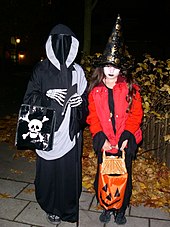
Halloween or Hallowe'en (a contraction of its original title "All Hallows' Evening") also known as All Hallows' Eve is a yearly holiday observed around the world on October 31, the eve of the Western Christian feast of All Hallows. Most scholars believe that All Hallows' Eve was originally influenced by western European harvest festivals and festivals of the dead with pagan roots, particularly the Celtic Samhain.Others maintain that it originated independently of Samhain.
Typical festive Halloween activities include trick-or-treating (also known as "guising"), attending costume parties, carving pumpkins into jack-o'-lanterns, lighting bonfires, apple bobbing, visiting haunted attractions, playing pranks, telling scary stories, and watching horror films.
How did Halloween come about in Spain?
Halloween is more popular in the north of Spain due to ancestral links with celtic ancestors who arrived in this region around 3,000 years ago. Despite mixing with the indigenous Iberian culture, a great interest came about in holidays and celebrations imported from the Celtic world.
How do they celebrate Halloween in Spain?
Although Halloween is still a relatively new phenomenon in Spain, the Spanish people go all out for celebrating it to the maximum as with any kind of fancy dress festival. You will see many more people dressed up in outrageous costumes and parading the streets in larger groups than you would ever see in England. It is more popular in the north of Spain and celebrated much more in larger cities where you are bound to be invited to a costume party or see posters advertising them everywhere. Most shops and cafes have baskets of treats outside for trick or treaters.
Along Galicia’s northern coast it is traditional to carve pumpkins, light bonfires and consume “quemadas” fire water infused with herbs – claimed to be an ancient drink originating from the Celtic people a symbolic act to burn off bad luck and the negative energy associated with Halloween.
Activities for halloween
26 de octubre de 2012
2012 PRINCE OF ASTURIAS AWARDS

The Prince of Asturias Awards (Spanish: Premios Príncipe de Asturias) are a series of annual prizes awarded in Spain by the Prince of Asturias Foundation to individuals, entities or organizations from around the world who make notable achievements in the sciences, humanities, and public affairs. The prize was established on 24 September 1980 by the twelve year-old Felipe, Prince of Asturias, heir to the throne of Spain, "to consolidate links between the Principality and the Prince of Asturias, and to contribute to encouraging and promoting scientific, cultural and humanistic values that form part of mankind's universal heritage." The awards are presented in Oviedo, the capital of the Principality of Asturias, at a ceremony presided by Felipe, Prince of Asturias.

A sculpture, expressly created for the prize by Spanish sculptor Joan Miró, is presented yearly to the recipients of the prize.
http://www.fpa.es/en/2012-special
17 de septiembre de 2012

12 de agosto de 2012
THE OLYMPIC GAMES

3 de junio de 2012
QUEEN'S DIAMOND JUBILEE
60 years of history in the UK, the world and the Royal Family

http://www.telegraph.co.uk/news/uknews/the_queens_diamond_jubilee/9308110/Diamond-Jubilee-Queen-voted-favourite-monarch-of-all-time.html
Interactive Queen's timeline.
http://www.telegraph.co.uk/news/uknews/the_queens_diamond_jubilee/9305109/Queens-Diamond-Jubilee-timeline-60-years-of-history-in-the-UK-the-world-and-the-Royal-Family.html
22 de abril de 2012
SAINT GEORGE'S DAY
Saint George is the patron saint of England. He's popularly
identified with England and English ideals of honour, bravery and
gallantry - but actually he wasn't English at all. Very little, if
anything, is known about the real Saint George. He is patron saint not only of England but also of Aragon, Catalonia,
Georgia, Lithuania, Palestine, Portugal, Germany and Greece; and of
Moscow, Istanbul, Genoa and Venice (second to Saint Mark). He's also
patron saint of soldiers, archers, cavalry and chivalry, farmers and
field workers, riders and saddlers, and he helps those suffering from
leprosy, plague and syphilis. In recent years he has been adopted as
patron saint of Scouts.
Everything about Saint George is dubious, so the information below should be taken as mythical rather than real.
- Born in Cappadocia, an area which is now in Turkey
- Lived in 3rd century AD
- His parents were Christian
- Later lived in Palestine
- Became a Roman soldier
- Protested against Rome's persecution of Christians
- Imprisoned and tortured, but stayed true to his faith
- Beheaded at Lydda in Palestine
- 23rd April was named as Saint George's day in 1222

England
"St George's Day" is celebrated by the several nations, kingdoms, countries, and cities of which Saint George is the patron saint. St George's Day is celebrated on 23rd April, the traditionally accepted date of Saint George's death in AD 303. For Eastern Orthodox Churches who use the Julian calendar, 23rd April corresponds to 6th May on the Gregorian calendar.

A traditional custom on St George's day is to wear a red rose in one's lapel, though this is no longer widely practised. Another custom is to fly or adorn the St George's Cross flag in some way: pubs in particular can be seen on 23rd April festooned with garlands of St George's crosses. It is customary for the hymn "Jerusalem" to be sung in cathedrals, churches and chapels on St George's Day, or on the Sunday closest to it. Traditional English foods and drink (e.g. afternoon tea) may be consumed.
Spain

As in the rest of the ancient Crown of Aragon, the Feast of St George is celebrated enthusiastically in the Community of Aragon,
being the country's patron saint and its national day. As in Catalonia, roses and books are exchanged among individuals, often bearing ribbons with the colors of Aragon's flag. Valencia celebrates St George's Day with a different intensity, though in several zones it has similarities to Valentine's Day, like in Catalonia.

 April 23rd was chosen as World Book Day and Copyright Day, because it corresponds to the demise of the writers Miguel de Cervantes, William Shakespeare and Inca Garcilaso de la Vega on the same date in 1616 (although it really is not : Cervantes died on 22nd and was buried on 23rd, while Shakespeare died on April 23rd ... in the Julian calendar, which corresponds to 6th May in the Gregorian calendar). On this date also died William Wordsworth (in 1850) and Josep Pla (in 1981).
 The International Publishers Association proposed this date to Unesco, with the aim of promoting culture and the protection ofintellectual property through copyright.


8 de abril de 2012
EASTER
Easter has been called a moveable feast because it doesn't fall on a set date every year, as most holidays do. Instead, Christian churches in the West celebrate Easter on the first Sunday following the full moon after the vernal equinox on March 21. Therefore, Easter is observed anywhere between March 22 and April 25 every year.
Easter Sunday is the culmination of Holy Week. Easter commemorates the resurrection of Jesus Christ. It is the most important Christian festival, and the one celebrated with the
greatest joy. The date of Easter changes each year, and several other Christian festivals fix their dates by reference to Easter. Churches are filled with flowers, and there are special hymns and songs. But not all Easter customs are Christian; some, such as the Easter Bunny, are pagan in origin.
The exact origins of this religious feast day's name are unknown. Some
sources claim the word Easter is derived from Eostre, a Teutonic goddess
of spring and fertility. Other accounts trace Easter to the Latin term "hebdomada alba", or white week, an ancient reference to Easter week and
the white clothing donned by people who were baptized during that time.
Through a translation error, the term later appeared as "esostarum" in Old
High German, which eventually became Easter in English.
In Spanish, Easter is known as Pascua; in French, Paques. These words are derived from the Greek and Latin Pascha or Pasch, for Passover. Jesus' crucifixion and resurrection occurred after he went to Jerusalem to celebrate Passover (or Pesach in Hebrew), the Jewish festival commemorating the ancient Israelites' exodus from slavery in Egypt. Pascha eventually came to mean Easter.
Easter Bunny

According to some sources, the Easter bunny first arrived in America in the 1700s with German immigrants who settled in Pennsylvania and transported their tradition of an egg-laying hare called "Osterhase" or "Oschter Haws." Their children made nests in which this creature could lay its colored eggs. Eventually, the custom spread across the U.S. and the fabled rabbit's Easter morning deliveries expanded to include chocolate and other types of candy and gifts, while decorated baskets replaced nests. Additionally, children often left out carrots for the bunny in case he got hungry from all his hopping.
Easter Eggs

Easter Candy

2 de abril de 2012
HOLY WEEK IN SPAIN
Seville, Málaga, Zamora and León hold elaborate processions for Holy Week. A tradition that dates from medieval times which has spread to other cities in Andalusia.


Processions in Granada.

It is hard to choose between the different processions,
but perhaps the favourite two are the "Silent Procession" on
Thursday (when the street lights along the route are turned off and
the procession takes place
in absolute silence) and the "Gypsy Procession" on Wednesday
(which goes through the Albaicín/Sacromonte quarter). During
the Gypsy Procession, bonfires are lit along the route and stops are
made every
so often for "saetas" (traditional
songs to Jesus or the Virgin) to be sung.
16 de marzo de 2012
1812-2012. ¡VIVA LA PEPA! BICENTENNIAL OF THE SPANISH CONSTITUTION
 |
| The promulgation of the Constitution of 1812, oil painting by Salvador Viniegra (Museo de las Cortes de Cádiz). |
Viva la Pepa! is the cry with which from the March 19, 1812 (Feast of St. Joseph) Spanish liberals proclaimed their adherence to the Constitution of Cadiz (proclaimed that day, and popularly known as La Pepa).
The great popularity that was the cry, its roundness and its ease of dissemination even in circumstances of political repression as those who arrived between 1814 and 1820 (absolute restoration of Ferdinand VII), and between 1823 and 1833 (reestablishment) made it perhaps the first political slogan of the contemporary age.
http://en.wikipedia.org/wiki/Spanish_Constitution_of_1812
26 de febrero de 2012
THE DAY OF ANDALUSIA

The Friday before is often a day of celebration in schools with a traditional Andalusian breakfast (desayuno andaluz), consisting of a slice of toast with a thin layer of olive oil and orange juice; students color pictures that refer to the symbols and insignia of Andalusia, its history and customs, put on plays and sing the regional anthem, the Himno de Andalucía.

18 de febrero de 2012
CARNIVAL OF CADIZ
The Carnival
of Cádiz is one of the best-known carnivals in Spain. The whole city
participates in the carnival for more than two weeks each year, and the
presence of this fiesta is almost constant in the city because of the
rehearsals, recitals, and contests held throughout the year.
It is a
widely-held opinion that the city of Cádiz is blessed with the wittiest people
in Spain, so it is not surprising that the main
characteristics of the carnival in Cádiz are the acerbic criticisms, the droll
plays on words, stinging sarcasm, and the irreverence of parody. While some
carnivals, elsewhere in the world, stress the spectacular, the glamorous, or
the scandalous in costumes, Cádiz distinguishes itself with the sheer
cleverness and fertile imagination of its carnival attire. It is traditional to
paint the face as a humble substitute for a mask.
It is easy to
get involved in the fiesta even if one is a visitor and knows no Spanish. On
Saturday, everyone wears a costume, which, many times, is related to the most
polemical aspects of the news. However, the Carnival of Cádiz is most famous
for the satirical groups of performers called chirigotas. Their music and their
lyrics are in the centre of the carnival.
The most
famous groups are the chirigotas, the choirs, and the comparsas.


Other groups
can be found in the streets: the quartets (cuartetos), that, oddly, can be
composed of five, four, or three members. They don't bring a guitar, only a
kazoo and two sticks, that they use to mark the rhythm. They use set-piece
theater scenes (pre-written skits), improvisations, and music, and they are
purely comical.
The minimalist
carnival groups in Cádiz are the romanceros, perhaps the oldest, and,
certainly, the most invariant carnival representation in Cádiz throughout
history. A romancero is a single costumed person who brings a big easel on
which posters help him to tell a story with images. The romancero recites
humorous verses while pointing at aspects of the pictures and drawings with a
long stick.
Suscribirse a:
Entradas (Atom)